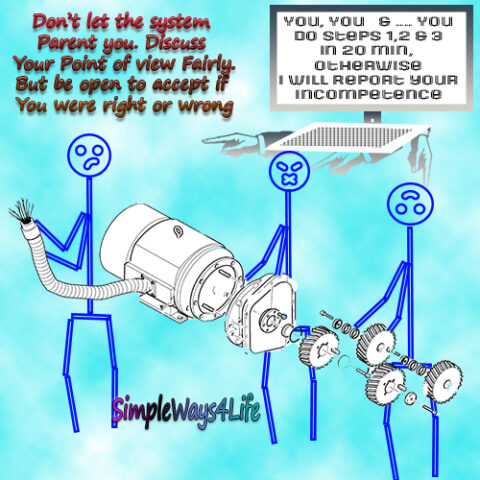
Effective maintenance does not rely only on procedures, tools, or experience. It relies heavily on how people think together. Teams that maintain distance, hide mistakes, or avoid difficult conversations slowly lose their ability to improve. Deep thinking requires openness, and openness requires trust.
In a healthy maintenance team, people can clearly say, “I don’t know how to do this,” without feeling exposed or judged. That honesty saves time, prevents errors, and builds real competence. The same applies to admitting mistakes. When errors are discussed openly, they become learning opportunities instead of recurring failures.
These teams also allow space for ideas to emerge without ego. Someone can say, “I tried this and it did not work,” or “I have a new idea worth testing,” and the response is curiosity, not resistance. There is no bullying, no hidden agendas, and no unnecessary mystery. Communication stays direct and respectful.
Individual differences are not a weakness in this environment. Some people prefer to go deep into details, while others focus on the bigger picture. Both perspectives are valuable. Even jealousy, when it appears, becomes a constructive trigger. It highlights gaps in knowledge and motivates improvement instead of creating conflict.
The result is a strong advantage for the organization. Decisions improve, rework decreases, and execution becomes more reliable. At the same time, individuals grow professionally. They gain confidence, clarity, and the ability to think systemically rather than react emotionally.
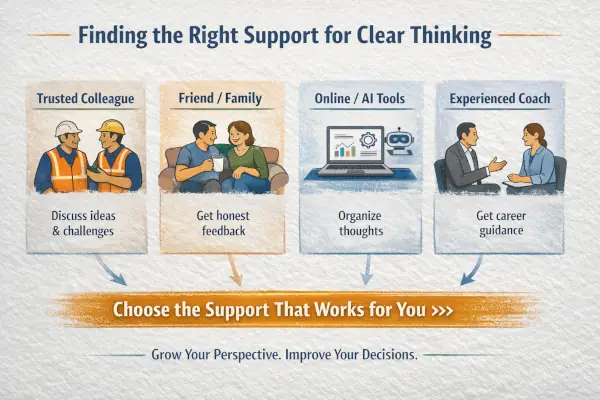
However, not everyone has access to such a team. In some workplaces, openness is still risky, and deep thinking is discouraged. When this happens, it is important not to stop developing your thinking skills. Finding even one person who can play this role makes a difference. This could be a trusted colleague, a friend, someone online, or a mix of all three.
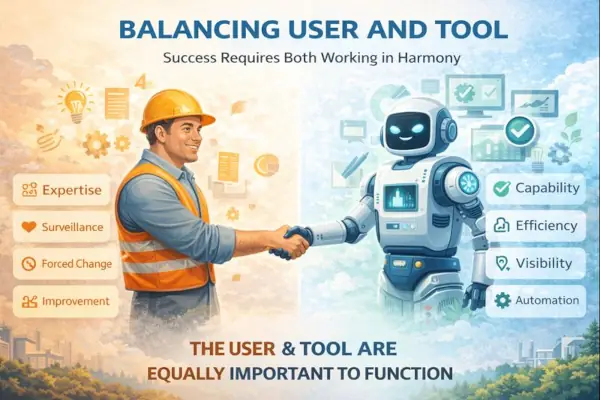
AI tools can support thinking, structuring, and exploration, but they do not replace human experience and judgment. A human coach brings perspective, context, and lived experience. A good coach helps you step back, understand the bigger picture, and decide where to focus your energy, especially in complex career and management situations.
Deep thinking is not a luxury. It is a requirement for reliable maintenance and long-term growth. Whether through a strong team or the right coach, it should never be done in isolation.
Trusted Colleague Support
A trusted colleague is often the first and most accessible form of support. This is someone who understands the technical context, the constraints of the organization, and the real-world pressures of maintenance work. Conversations with such colleagues are practical and grounded, focusing on what actually works rather than what looks good on paper.
This type of support is especially valuable for discussing ongoing issues, failed attempts, and alternative approaches. A trusted colleague can challenge assumptions, highlight blind spots, and share lessons learned from similar situations. Because the context is shared, feedback is usually fast and highly relevant.
However, this support depends heavily on psychological safety. Without trust, conversations become filtered and shallow. When trust exists, a colleague becomes a thinking partner who helps improve decisions and execution quality without formal roles or hierarchy.
Friend and Family Support
Friends and family provide a different kind of support that is often underestimated. They may not understand the technical details of maintenance or management, but they offer emotional stability and honest reflection. This distance from the technical context can actually be an advantage.
By listening without organizational bias, friends and family help clarify thinking. Explaining a problem to someone outside the field forces simplification, which often reveals core issues. Their questions are usually direct and unfiltered, helping identify assumptions that professionals sometimes overlook.
This type of support is particularly useful during stressful periods, career uncertainty, or decision fatigue. While they should not replace professional judgment, friends and family help maintain balance, resilience, and perspective, which directly affects decision quality at work.
Online and AI Support
Online tools and AI systems provide fast, structured, and always-available support. They are effective for organizing thoughts, exploring scenarios, documenting ideas, and testing logic. This type of support is especially useful when working alone or outside normal working hours.
AI tools help remove noise from thinking. They can summarize options, compare approaches, and highlight risks without emotional influence. This makes them valuable for early-stage analysis, preparation for discussions, or refining ideas before sharing them with others.
However, AI lacks lived experience and organizational context. It does not fully understand culture, politics, or human dynamics. For this reason, AI support works best as a complement, not a replacement, to human judgment and experience.
Experienced Coach Support
An experienced coach provides structured, intentional support focused on long-term growth and decision quality. Unlike colleagues, a coach is independent from internal politics and performance pressure. This neutrality creates a safe space for honest thinking and difficult conversations.
A good coach helps zoom out and see the bigger picture. They connect daily decisions to long-term career direction, leadership style, and organizational impact. Through guided questioning and reflection, a coach helps identify where to focus effort and where to stop wasting energy.
This type of support is particularly valuable during transitions, increased responsibility, or complex management situations. A coach does not provide answers but strengthens thinking, judgment, and confidence. Over time, this leads to better decisions, stronger leadership presence, and more reliable outcomes.