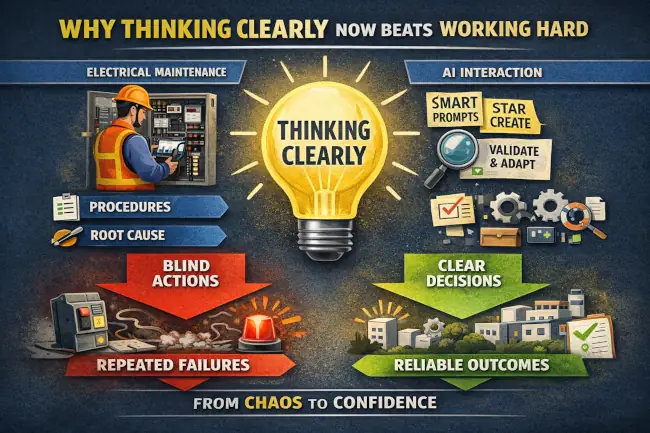
For years, we believed success came from working harder. However, today Thinking Clearly is becoming the real advantage. The shift did not happen overnight, but AI has made it impossible to ignore.
This shift is even more critical in industrial electrical maintenance within the AI era. A technician may follow a procedure perfectly and still miss the real issue. For example, replacing components without understanding failure patterns often leads to repeated faults. Here, Thinking Clearly means defining the problem, not just executing the task or accepting a superficial answer from an AI agent that lacks context. It connects symptoms to root causes and turns routine work into reliable outcomes. Without this discipline, relying on AI in electrical maintenance quickly becomes messy and misleading.
A clarifying relevant example, can be seen in the software realm where in the past many professionals focused on writing code that worked. They learned languages like C++, Java, and Python. Yet, they often struggled to explain what the code should truly achieve. As a result, effort was high, but direction was not always clear.

Now, AI changes how we work. It removes much of the execution burden. However, it demands something different in return. You must describe your needs clearly, structure your requests, and refine them step by step. In this environment, Thinking Clearly drives the quality of every outcome.
At first, this shift may feel like a downgrade. Less technical struggle, more communication. However, this view misses the point. The real skill was never typing code. It was defining the right problem, asking the right question, and validating the result with confidence.
Why Thinking Clearly Defines Procedures in Electrical Maintenance Today
In electrical maintenance, procedures are critical for safety and consistency. They protect both people and equipment from serious harm. For this reason, teams rely on them as trusted guidance in daily work. However, procedures alone cannot cover every real situation on the shop floor.
In practice, technicians often face conditions that differ from documented steps. Equipment ages, environments change, and failure modes evolve. When this happens, strict execution without reflection can lead to repeated faults or missed risks. This is where Thinking Clearly becomes essential to interpret the situation beyond the written steps.

For example, a recurring breaker trip may lead to repeated component replacement. The procedure may be followed correctly each time. Yet, the real issue could be load imbalance, insulation degradation, or an intermittent fault. Without stepping back and Thinking Clearly, the team keeps solving the symptom instead of the cause.
AI tools can disrupt this cycle, both positively and negatively. An AI agent may suggest logical steps based on general patterns. However, it often lacks full context, site history, and subtle field conditions. If technicians accept these outputs without validation, they risk reinforcing incorrect actions with greater confidence.
On the other hand, AI can introduce new perspectives. It can surface possible causes drawn from broader knowledge that may not exist in the local workplace history. In some cases, these external insights point directly to the true root cause of repeated failures.
Therefore, Thinking Clearly must define how procedures are applied and how AI recommendations are accepted, not just how they are followed. It requires questioning results, validating assumptions, and adapting actions to real conditions. Procedures remain the foundation, while Thinking Clearly ensures they lead to safe and reliable outcomes.
Structured Requests: Thinking Clearly Before Asking AI
Thinking Clearly in Job Plans: From Instructions to Intent
In planned work, clarity should exist before execution begins. However, many job plans focus on steps, not intent. They describe what to do, but not why it matters or what success looks like. As a result, even well-written plans can lead to inconsistent outcomes.
When AI enters this space, the same gap becomes more visible. If the request is vague, the output will be generic. If the context is missing, the result will not fit the real condition. Therefore, Thinking Clearly must start before asking AI, not after receiving the answer.
A strong job plan today combines structure with intent. This is where frameworks like SMART, STAR, ABCD, and PEAR become practical tools, not theory. They help define the objective, the conditions, and the expected result. In the same way, the CREATE formula strengthens how we guide AI by providing context, requirements, and evaluation criteria.
You explored this approach in Can AI Be Your Smartest Right Hand? Think Prompt and CREATE Formula Transcends AI into the Most Reliable Maintenance Ally. Both show that structured requests lead to more reliable outputs and fewer iterations.
In practice, Thinking Clearly means asking AI as you would define a critical job. You describe the equipment, the condition, the constraints, and the expected outcome. Then, you review the response with the same discipline used to validate a completed task. This approach turns AI into a support tool, not a shortcut.
Thinking Clearly in Emergencies: When Speed Meets Clarity
Emergencies test more than technical skill. They test judgment, communication, and control under pressure. As I described in Chaos is Inevitable — Panic is Optional, the first reaction often shapes everything that follows.
In these moments, AI can either support or amplify confusion. A rushed, unclear request will produce scattered guidance. This adds noise instead of clarity. Therefore, even under pressure, Thinking Clearly remains essential.
This does not mean slowing down the response. It means structuring it. A clear situation summary, a defined objective, and a focused question can transform the quality of AI support within seconds. Without this, teams risk acting on partial or misaligned recommendations.
At the same time, emergencies create opportunities for AI to add value. It can suggest alternative causes, highlight overlooked risks, or recall similar failure patterns. However, these inputs must be filtered through field awareness and experience. AI does not see the environment. It only interprets what it is given.
Therefore, Thinking Clearly in emergencies means controlling both the situation and the input to AI. It ensures that speed does not replace judgment. It also ensures that decisions remain grounded, even when the pressure is high.
Then what?
This shift does not end with asking better questions. It continues with how we handle the answers. In the next article, we will explore how to audit results, adjust direction, and stay open to what we do not fully understand. This is where Thinking Clearly meets ownership. It is also where many in coding and AI-assisted work struggle today. Fast outputs can create false confidence if they are not challenged. Therefore, learning to question, refine, and even admit gaps becomes the real skill behind reliable outcomes.
If you feel you need help with any of these ideas we discussed, request a Management Consultancy or Coaching Services From our Store