In the previous article, we explored deep thinking, support systems, coaching, and the role teams play in good decision-making. We discussed how people grow through interaction, challenge, and shared experience. That discussion naturally leads to an important question. Where do digital tools and AI fit in this picture?
Digital tools are now everywhere and can help maintenance and reliability teams. We use them to plan, analyze, record, and optimize. AI models can answer questions instantly. They can guide thinking and structure analysis. This creates a tempting idea. Can a digital tool replace a mentor? Can an AI agent become a team member?
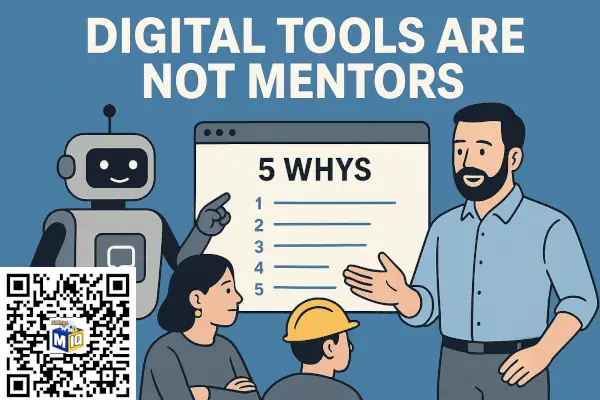
This article sets my clear ideas about this topic. Digital Tools are powerful, but Digital Tools are not mentors. They support thinking. They do not replace human judgment, experience, or context. Understanding this boundary is critical for healthy teams and reliable decisions.
Digital Tools as Enablers, Not Replacements
Digital Tools have changed how maintenance teams work. We can use them to capture failure data, schedule work, analyze trends, and document decisions. These tools reduce friction and improve consistency. They help teams work faster and remember better.
AI takes this further. It can suggest causes, propose structures, and guide users step by step. For young engineers, this feels like mentorship. The tool explains. It responds. It never gets tired. However, this similarity is misleading.
Mentorship is not only about answers. It is about experienced judgment. It is about knowing -from a wider prospective- what matters and what does not. A mentor reads the room. A mentor senses hesitation, bias, or missing voices. Digital Tools cannot do that, no matter how advanced they become.
Digital Tools work on what you provide. If the context is incomplete, the outcome will be incomplete. If the problem is framed poorly, the guidance will follow that path. A mentor challenges the framing itself. That is the difference.
The Risk of Treating AI as a Mentor
Taking an AI model as a mentor feels efficient, but it is not healthy in the long term. You may explain the context in detail. You may refine the prompts. Still, something essential is missing. The human touch.
Maintenance problems live in reality. They include shortcuts, habits, stress, workload, and culture. These elements rarely appear in data or descriptions. People on site feel them. Experienced engineers recognize them. Digital Tools do not have this experience. They only process representations of it.
There is also a silent risk. Over-reliance on digital guidance can weaken team interaction. People stop asking each other. Discussions shrink. Learning becomes private instead of shared. Reliability, however, grows through collective understanding, not isolated analysis.
That said, Digital Tools can still play an important role. When no mentor exists, when teams are isolated or, when time is limited. In these cases, a good tool is better than no support at all. The danger is not in using the tool. The danger is believing it replaces people.
Can a Digital 5 Whys Tool Be a Team Member?
The 5 Whys method is a perfect example. On paper or a whiteboard, it often feels boring or intimidating. People rush it. Some avoid it. Others turn it into a form-filling exercise. Digital Tools can help here.
A digital 5 Whys tool can guide structure. It can remind users to stay factual. It can store past analyses and retrieve similar cases. This reduces friction and improves discipline. In this sense, the tool is a strong assistant. That’s where MaintIQ fits
However, a 5 Whys analysis cannot be done alone with an AI agent. The method depends on real people. Operators, technicians, supervisors, and engineers each hold part of the truth. The answers to “why” are not opinions. They are facts grounded in work reality.
If only one person and an AI tool perform the analysis, the result will be shallow. Important details will be missed. Bias will remain unchallenged. The analysis may look clean, but it will not be reliable. 5 Whys needs humans from the context of the problem.
Where Digital Tools Truly Add Value
Digital Tools shine when they support collaboration, not replace it. A good 5 Whys digital tool can act like a facilitator. It helps teams capture discussions clearly, preserves learning and, avoids repeating the same mistakes.
MaintIQ as a tool acts a shared memory because it allows users to retrieve previous analyses. It shows patterns over time. It helps leaders see systemic weaknesses instead of isolated events. This is where Digital Tools become powerful allies.
In a coming article, we will explore the next version of MaintIQ. When the tool provides statistics across all 5 Whys analyses. Moreover it will highlight recurring causes and enable collaboration between teams and sites. Not as a mentor, but as a platform for collective intelligence.
Finally, digital Tools are not mentors. They never will be. Mentorship lives in experience, judgment, and human connection. Still, Digital Tools can be strong companions. They can guide structure, reduce effort, and amplify learning.
Use AI and digital tools wisely. Let them support thinking, not replace it. Keep people at the center of analysis. That is how maintenance and reliability truly improve.