
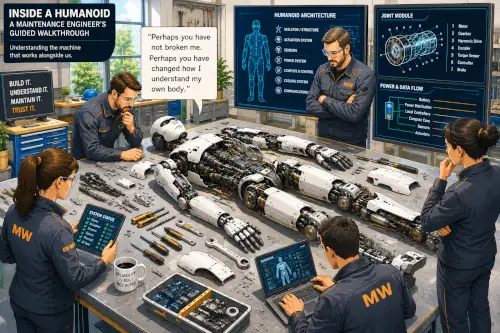
An Engineer’s Guide to Robot: Most maintenance engineers have the same instinct. Posted 05 August 2026 on MaintenanceWorld.com
I have always been fascinated by emerging technologies. Today, the idea of humanoids working alongside us—in our workplaces and perhaps one day in our everyday lives—is moving rapidly from science fiction to engineering reality.
Driven by that curiosity, I invite you on an imaginary yet technically grounded journey inside one of our future colleagues. Rather than seeing a humanoid through the eyes of an AI researcher, I chose to explore it through the eyes of a curious maintenance engineer.
If you’ve ever wondered what lies beneath the outer shell and how these remarkable machines are physically built, I hope you’ll enjoy the journey. I’ll make an intro here and you will find the complete Journey on Maintenanceworld.com.
When a new machine arrives, they rarely stop at reading the brochure. They want to know what is inside and understand how every subsystem contributes to the whole machine. They mentally dismantle it, trace signals, inspect components, and imagine failure modes long before writing first maintenance schedule.
Imagine, then, that your newest maintenance colleague is not another technician but a humanoid robot. During a planned shutdown, your team decides—not to repair it—but to explore how its built. The humanoid willingly participates, explaining how to remove each subsystem as its outer panels.
This article follows that imaginary conversation. While fictional, every subsystem described reflects technologies that already exist in today’s advanced humanoid robots. By the end, you will not simply know what a humanoid can do—you will understand the Robot physically construction, why each component exists, and which maintenance disciplines come together to keep it operating.
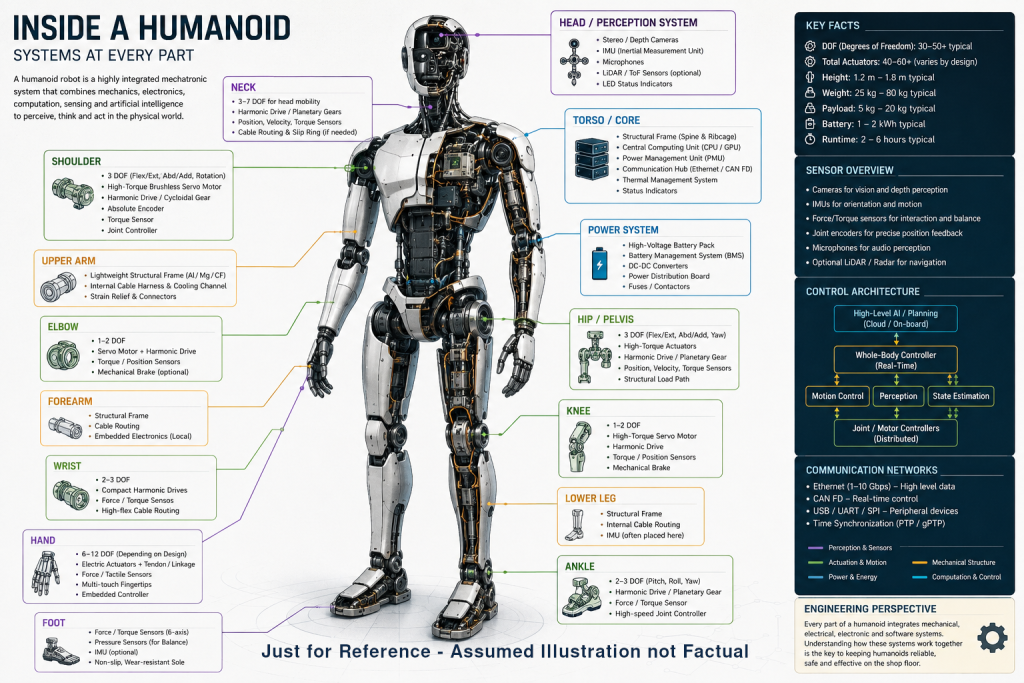
Removing the Outer Shell: The First Engineering Explorations
As the maintenance team begins removing the external body panels, the first surprise is how familiar the internal architecture appears. Although humanoid robots often attract attention because of their human-like appearance, their internal construction is fundamentally an integration of well-established engineering disciplines rather than entirely new technology. Beneath the cosmetic shell are structural members, electrical harnesses, communication networks, distributed control electronics, sensors, actuators, thermal management components, and power distribution systems—many of which would be recognizable to engineers working with modern industrial automation.
External Body
The external covers themselves are designed with multiple objectives in mind. Besides providing an anthropomorphic appearance, they protect internal components from dust and accidental contact, improve aerodynamic flow for cooling in some designs, reduce noise transmission, and provide safe interaction surfaces for humans. Depending on the manufacturer, these panels are commonly fabricated from engineering plastics, carbon-fiber composites, glass-fiber reinforced polymers, or lightweight aluminum assemblies. Material selection is always a compromise between impact resistance, stiffness, weight, manufacturability, repairability, and cost. Similar design trade-offs are already familiar in industries such as aerospace, automotive, and collaborative robotics.