Most projects finish with an impressive collection of documents. Drawings, manuals, procedures, certificates, spare parts lists, maintenance schedules, and operating instructions all arrive neatly packaged – Just make sure it is included in the contract and ensure to ask for it-. However, the knowledge transfer is rarely mentioned anywhere.
Yet many organizations discover that six months later, they still depend on the supplier for answers.
The problem is rarely missing documentation. It is missing understanding.
Documentation records information. Knowledge enables decisions.
Successful suppliers recognize that knowledge transfer is not a single handover activity. It is a continuous process that begins with documentation and continues through training, commissioning, startup support, and long-term technical collaboration.
The goal is not simply to explain what should be done. It is to ensure that people understand why decisions were made, how situations should be handled, and what experienced engineers have learned from years of practical operation.
“Documents explain what. Knowledge explains why, how, and the tricks that only experience can teach.”
That single idea transforms every stage of project delivery

Documentation That Teaches
Many manuals successfully explain what operators should do. Far fewer explain why those actions matter.
Good documentation does far more than list procedures. It helps engineers understand the reasoning behind design choices, operating limits, maintenance intervals, and safety precautions. When people understand the logic, they can adapt confidently when real-world conditions differ from the manual.
Consider a simple maintenance instruction:
“Replace the filter every 2,000 operating hours.”
The instruction is clear, but it leaves important questions unanswered.
- Why 2,000 hours?
- What failure mechanism is being prevented?
- How do dusty environments affect this interval?
- What warning signs indicate early blockage?
- What performance changes should operators monitor?
- What damage could result from delaying replacement?
By answering these questions, documentation evolves from a procedure into a learning resource. It transfers engineering judgment alongside technical information.

Effective documentation should consistently explain:
- what to do,
- why it is necessary,
- how it should be performed,
- operating assumptions,
- limitations,
- common mistakes,
- maintenance recommendations,
- and practical observations gathered from field experience.
When documentation teaches rather than merely instructs, organizations become less dependent on external expertise and more capable of making sound operational decisions.
Training That Builds Confidence by Knowledge Transfer
Training often focuses on button sequences, menus, and procedures. Participants learn where to click but not why the system behaves as it does.
Confidence grows from understanding, not memorization.
Effective training explains the engineering philosophy behind the equipment. It connects operational tasks with design intent and demonstrates how individual actions influence safety, reliability, efficiency, and product quality.
Instead of presenting isolated procedures, suppliers’ training should discuss:
- engineering decisions,
- operating philosophy,
- process interactions,
- troubleshooting strategies,
- safety reasoning,
- real operating examples,
- lessons from previous installations.
Engineers remember stories far longer than presentation slides. A discussion about an actual commissioning problem, a costly shutdown, or an unexpected equipment failure often teaches more than dozens of PowerPoint slides.
Training should prepare people for situations they have not yet encountered. When unexpected conditions arise, they should understand how to think through the problem rather than search for an exact matching instruction.
Commissioning That is Built around Knowledge-Transfer
Commissioning is sometimes viewed as the supplier’s responsibility while the customer’s team observes from the background. However many customers and suppliers agree to share a well-selected customer team in the commissioning project to build the ownership of the new project within the customer’s team.
The first approach wastes one of the richest learning opportunities in the entire project life cycle. While, the second one is a Best-practice guidance explicitly describing commissioning as a team effort involving the owner/customer, supplier/OEM, contractors, and a commissioning agent, with clear roles but shared responsibility. Owners are encouraged to assign commissioning team members, participate actively, and treat vendors as commissioning partners, not just product suppliers. This turns commissioning to a structured coaching process.
Rather than performing every task themselves, supplier specialists should gradually shift responsibility to the customer’s engineers while providing guidance and supervision.
The objective changes from:
Supplier works. Customer watches.
to
Customer performs. Supplier coaches.
This simple shift creates lasting capability without overriding supplier responsibility.

Commissioning should actively involve customer personnel in:
- functional testing,
- instrument calibration,
- loop checks,
- fault simulation,
- alarm verification,
- recovery procedures,
- maintenance tasks,
- startup sequences,
- shutdown procedures,
- operational adjustments.
People learn far more from performing these activities than from observing them.
By the time commissioning concludes, the operating team should possess not only procedural familiarity but also the confidence to diagnose problems independently.
Maintenance Coupons
Maintenance Coupons
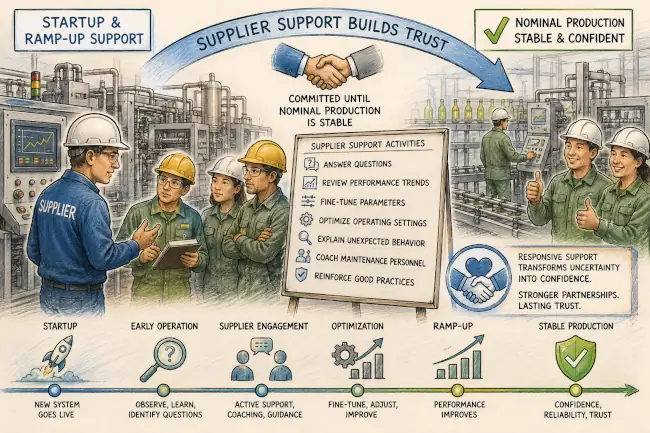
Startup & Ramp up Support Build Trust
Knowledge transfer does not end when the equipment begins production.
The first weeks of operation often reveal practical questions that no training session can fully anticipate. Why? Because every production environment is unique.
Different products, environmental conditions, operator habits, and maintenance practices expose situations that only become visible during real operation.
This is where supplier support creates lasting value.
During startup, suppliers should:
- answer operational questions,
- review equipment performance trends,
- fine-tune parameters,
- optimize operating settings,
- explain unexpected behavior,
- coach maintenance personnel,
- reinforce good operating practices.
Organizations remember suppliers who remain engaged not only during this critical period but who extend their support until nominal production is stable.
Responsive startup support transforms uncertainty into confidence and strengthens long-term partnerships built on trust rather than contractual obligation alone. This is strongly complemented by ramp-up support.
Maintenance Coupons
Maintenance Coupons
Knowledge That Stays
The most valuable knowledge is the knowledge that remains available long after the project team has moved on.
Today’s digital technologies allow suppliers to extend knowledge transfer far beyond printed manuals.
Practical tools can include:
- QR codes linked to maintenance procedures,
- short instructional videos,
- digital twins for visualization,
- annotated engineering drawings,
- troubleshooting decision trees,
- searchable knowledge bases,
- lessons learned from previous projects,
- maintenance history linked to equipment,
- online communities where engineers exchange practical experience.
Each resource captures insights that would otherwise disappear when experienced personnel leave the organization.
Together, these tools create a living knowledge ecosystem that evolves throughout the asset’s lifecycle.
Knowledge transfer is no longer an event at project handover. It becomes an ongoing partnership that continuously strengthens operational capability.
Conclusion
Equipment can be delivered in a matter of weeks. Knowledge takes longer to build, but it delivers value for decades.
Suppliers who focus only on delivering documentation fulfill a contractual requirement. Suppliers who invest in transferring understanding create capable operators, confident maintenance teams, and stronger long-term relationships.
Every interaction becomes an opportunity to teach:
- Documentation explains decisions.
- Training develops confidence.
- Commissioning builds experience.
- Startup support reinforces learning.
- Digital tools preserve expertise.
- Continuous collaboration transforms information into organizational knowledge.
In the end, successful projects are not measured by the number of manuals handed over. They are measured by how confidently people can operate, maintain, troubleshoot, and improve the systems after the supplier has left.
And that is the true purpose of knowledge transfer.
If you feel you need help with any of these ideas we discussed, request a Management Consultancy or Coaching Services From our Store