A project changes its character when installation begins. Plans become physical work, decisions meet real conditions, and responsibilities become visible on the shop floor. This is where Mutual Trust either grows through daily actions or slowly starts to weaken.
But how do you build it in practice? What should you do as a buyer while installation progresses? How can you follow the work closely without turning trust into micromanagement? How can you use those moments to build your team’s knowledge before handover? And, from the supplier side, how do you demonstrate commitment, protect the buyer’s confidence, and deliver exactly what you promised without unnecessary gold plating?
This article follows the project step by step, from both sides. Rather than discussing trust as a theory, we will look at what both parties can actually do during execution. Because Mutual Trust is not created by saying “we trust each other.” It grows when both sides stay close to the work, communicate openly, respect their commitments, and keep sight of the agreed outcome.

Mutual Trust Starts with Staying Close to the Work
Once installation begins, the buyer should not disappear until the next formal progress meeting. Equally, the supplier should not treat the site as a closed space where only its team understands what is happening.
This does not mean the buyer needs to watch every cable, bolt, or installation activity. That approach quickly becomes micromanagement. Instead, the buyer should stay close enough to understand how the project is taking shape.
Regular site presence makes a difference. Walk through the installation. Ask what was completed and what comes next. Compare the physical work with the agreed plan. Look for emerging concerns while they are still small and manageable.
The supplier also has a role in making this possible. Keep progress visible and communicate openly about what is happening. Do not wait for a formal meeting to raise an issue that may affect the project.

Maintenance Coupons

Maintenance Coupons
This is where Mutual Trust becomes practical. The buyer gains visibility without interfering with execution. Meanwhile, the supplier demonstrates confidence by keeping the work open and understandable.
However, staying close does not mean changing the supplier’s scope every time someone sees a possible improvement. The buyer should distinguish between a genuine requirement and a new idea. Likewise, the supplier should listen carefully without automatically adding features beyond the agreed contract.
That balance protects Mutual Trust. The buyer stays informed without taking control. The supplier remains committed to the agreed outcome without unnecessary gold plating.

Bonus: Use Installation to Start Building Knowledge
Installation offers an opportunity that formal training cannot easily replace. The buyer’s technical team can see the equipment while it is still open and accessible. They can observe components, connections, interfaces, and installation choices before guards and covers hide them.
Therefore, the buyer should not limit site visits to managers or project representatives. Bring maintenance and operations people closer to the work when appropriate. Encourage them to observe, ask questions, and understand how the system is being assembled.
The supplier should also avoid waiting until formal training begins. Installation creates natural opportunities to explain the system and share practical knowledge. A short explanation at the right moment may be more valuable than several slides later.
This early involvement also strengthens Mutual Trust. The buyer sees that the supplier is not simply installing equipment and preparing to leave. The supplier sees an engaged customer who wants to understand the delivered system rather than discover everything after handover.
At the same time, both sides should respect boundaries. Learning from the work must not become interference with it. Questions should improve understanding, while instructions should follow the agreed project responsibilities.
Practical Takeaway from Staying Close
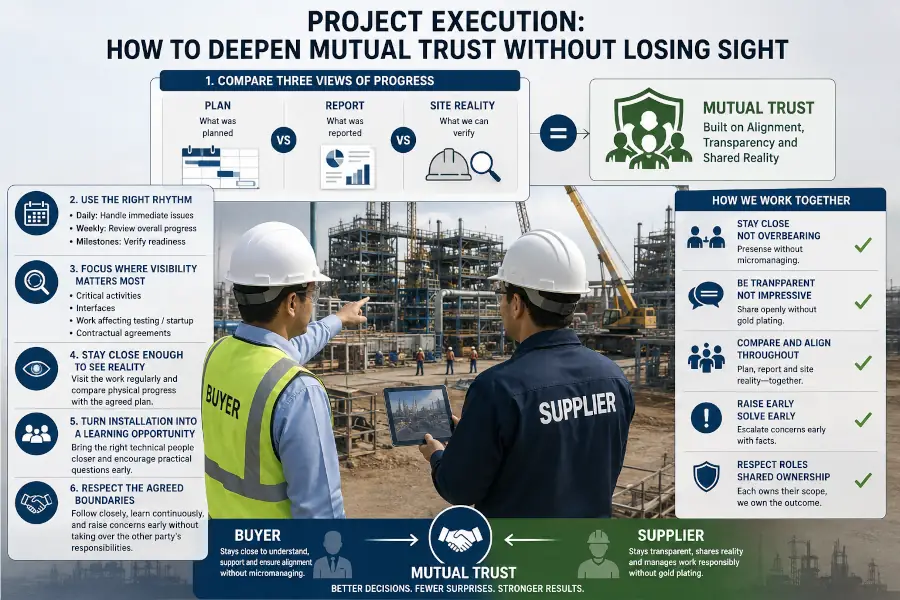
1. Stay close enough to see reality.
Visit the work regularly and compare physical progress with the agreed plan.
2. Turn installation into a learning opportunity.
Bring the right technical people closer and encourage practical questions early.
3. Respect the agreed boundaries.
Follow closely, learn continuously, and raise concerns early without taking over the other party’s responsibilities.
These simple actions create visibility, build knowledge, and strengthen Mutual Trust long before testing and handover begin.
Mutual Trust Needs a Shared View of Progress
Staying close to the work does not mean walking around the site without a clear purpose. Both parties also need a shared rhythm for reviewing progress, discussing concerns, and preparing for what comes next.
The buyer should know what to follow. At the same time, the supplier should know when and how progress will be reviewed. This creates visibility without constant interruption.
A good follow-up process does not require endless meetings. Instead, it connects regular communication with physical verification. Both parties should be able to compare what was planned, what was reported, and what actually exists on site.
This is another practical way to build Mutual Trust. Nobody needs to rely only on assumptions or optimistic updates. Progress becomes something both sides can see, discuss, and understand.
Don’t Let Charts Replace Reality
Schedules, progress reports, and S-curves are valuable tools. They help both parties understand whether the project follows the expected path. They can also reveal delays before they become critical.
However, a chart only reflects the information used to create it.
A progress report may show that installation is 80 percent complete. But what does that number really mean? Are the remaining activities simple finishing tasks? Or do they include critical interfaces, difficult connections, and unresolved problems?
Therefore, the buyer should not simply receive progress reports and move to the next agenda item. Review the figures, ask what they represent, and then compare them with the physical work.
Walk the site whenever possible. Look at completed activities and upcoming work. Check whether critical equipment has actually arrived, been installed, and reached the expected condition. Check if deliverables match the contract.
The supplier should also welcome this verification. It provides an opportunity to explain progress in its real context. A number alone may create the wrong impression. A discussion at the site often gives both parties a clearer picture before blaming and claiming.
Charts tell you where the project claims to be. The site helps you understand where it actually is.

This does not mean every percentage requires detailed inspection. The level of verification should reflect the importance and risk of the activity. Focus on critical paths, major interfaces, and work that may affect later testing or startup or contractual agreements.
When both sides see the same reality, Mutual Trust becomes easier to maintain. There are fewer surprises and less room for conflicting interpretations.
Create the Right Rhythm for Follow-Up
Not every issue needs a formal meeting. Likewise, waiting for a monthly review may allow small problems to grow. The key is to create a rhythm that matches the project’s activities.
Daily communication should address immediate issues. This can be a short discussion at the site. What was completed? What happens next? Is anything preventing today’s work? Where is this part? and so on…
Weekly follow-up should connect the bigger picture. Review progress against the schedule. Discuss interfaces, pending decisions, required resources, and emerging risks or conflicts. This is also a good time to review updated charts and compare planned progress with actual conditions.
Milestone reviews should confirm readiness. Before moving into an important phase, both parties should verify that the necessary work is genuinely complete. Do not move forward simply because the schedule says it is time.
At each level, the goal remains the same: create enough visibility without creating unnecessary administration. The supplier should not spend more time reporting than executing. The buyer should not demand meetings simply to demonstrate control.
A consistent rhythm also strengthens Mutual Trust. Both parties know when progress will be reviewed and how concerns can be raised. This reduces surprises and prevents routine questions from becoming unnecessary escalations.
Practical Takeaway
1. Compare three views of progress.
Review what was planned, what was reported, and what you can physically verify.
2. Use the right rhythm.
Handle immediate issues daily, review overall progress weekly, and verify readiness at major milestones.
3. Focus where visibility matters most.
Do not inspect everything equally. Pay closer attention to critical activities, interfaces, work that affects testing or startup and contractual agreements.
A shared view of progress does more than keep the schedule on track. It helps both parties see the same reality, address concerns early, and strengthen Mutual Trust throughout execution.
In Conclusion,
At this point, both parties are staying close to the work and sharing a realistic view of progress. However, even the best follow-up cannot prevent every problem.
Delays, unexpected conditions, technical issues, and changing circumstances will eventually test the relationship. The real question is not whether problems will appear, but how both parties respond when they do.
That is where we will go next: how to raise concerns early, solve problems without blame, and protect Mutual Trust when the project does not go exactly as planned.
If you feel you need help with any of these ideas we discussed, request a Management Consultancy or Coaching Services From our Store