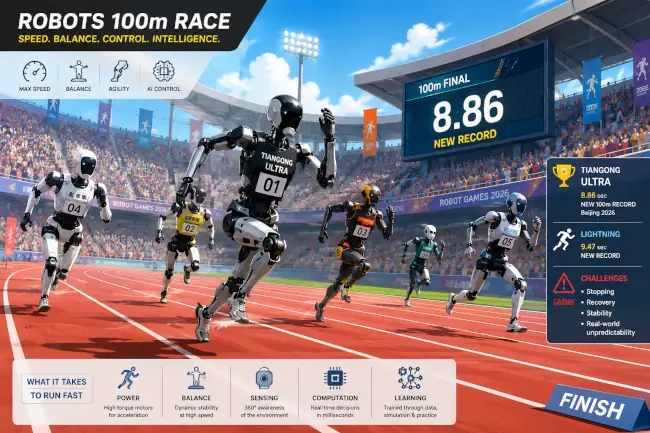
Can Robots Learn Industrial Tasks? We have seen humanoid robots dance, run marathons, and compete in athletic events. Is it real? . Posted 03 September 2026 on MaintenanceWorld.com
Is there some trick? Can we really train a robot for this? If so, why don’t we train them for something more helpful to maintenance, not just as a show? This sparked my curiosity and I started thinking “Sure those performances did not emerge from nowhere.” Looking around I found that behind them are real training methods—humans demonstrating, operators controlling, simulations creating millions of practice attempts, and algorithms learning through repeated feedback.
The question for maintenance is: Can we use the same principles to teach a humanoid to perform useful industrial work?
In the last article, we explored the subsystems inside a humanoid through a fictional journey[8]. Yet the technologies behind that journey already exist in today’s advanced robots. We explored what gives a humanoid its physical capabilities, why its components exist, and how different maintenance disciplines come together to keep it operating.
Before that, we examined where humanoids and physical AI could realistically fit on the shop floor[9].
Now, we move one step closer to reality.
Can this new colleague do useful maintenance work and help take maintenance to the next level?
That journey starts with a fundamental question: how do we train a robot to perform a real maintenance task?
Let’s delve into what is already happening—and what it could mean for maintenance.
Learning by Watching: Can a Robot Learn from a Technician?
This is where I would start because it immediately sounds familiar to every maintenance professional.
How did most of us learn our first practical maintenance tasks?
We watched someone.
An experienced technician did the job. We observed where they stood, which tool they selected, how they approached the component, and sometimes the small details that never appeared in any procedure. Then we tried it ourselves.
Teaching robots through human demonstration is not science fiction. It is an active area of robotics research known broadly as learning from demonstration or imitation learning.
And recent developments are becoming increasingly relevant to humanoids.
One particularly interesting example came from Figure in 2025. Its Helix system demonstrated human video-to-robot transfer. The company reported training its model on first-person human video and transferring the learned behavior to a humanoid robot, allowing it to navigate previously unseen, cluttered environments in response to natural-language instructions. Figure described this as Project Go-Big[1]: the robot behavior was transferred without collecting robot demonstrations for that particular environment.
This does not mean that we can simply record a technician replacing a pump bearing and expect a humanoid to perform the same job tomorrow.
There is a difficult problem in between.
You can continue reading the first 3 training methodologies here: MaintenanceWorld.com: Training the Next Maintenance Technician: Can Robots Learn Industrial Tasks
Next Month, we shall continue this trajectory with more practical training methods, be here