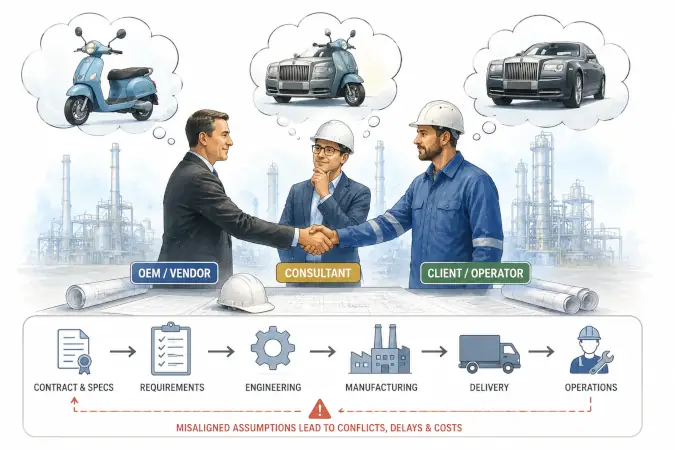
The inherited assumptions challenge becomes especially visible between OEMs and clients. OEMs typically design around contractual scope, performance guarantees, standardization strategies, and commercial boundaries. Clients, meanwhile, often envision operational flexibility, future expansion capability, maintainability, production resilience, and long-term reliability far beyond the initial startup phase. Both perspectives may appear technically correct, yet they do not always evolve from the same assumptions.
The previous discussion –The Digital Thread, How to Empower Us From Concept to Commissioning?!– explored how industrial projects inherit assumptions across every lifecycle stage and how weak continuity between decisions gradually compounds operational risk. Moreover, it creates misalignment between OEMs and Clients. However, preserving information alone does not automatically create alignment. Even when documentation, specifications, and communication channels remain available, projects can still drift away from operational reality because different stakeholders often define success differently from the beginning.

The GAP; Inherited Assumptions
The gap usually does not begin with bad intentions or technical incompetence. In many cases, it begins with silent inherited assumptions that nobody fully challenges during concept development, bid clarification, or detailed engineering reviews. An OEM may optimize motor sizing around the guaranteed process load while operations teams expect future de-bottlenecking capacity. A vendor may design equipment accessibility around installation requirements while maintenance teams later struggle with safe intervention space during shutdowns. A control philosophy may satisfy startup conditions perfectly while becoming restrictive during abnormal operating scenarios years later.
These disconnects often remain hidden because projects naturally focus on delivering equipment, schedules, and contractual milestones. However, operations eventually inherit the consequences of every design compromise, every unrecorded assumption, and every misunderstood expectation.
This is where the conversation around the Digital Thread becomes more practical and more human. The real challenge is no longer only preserving information. It is preserving shared understanding between OEM assumptions, engineering intent, and client operational reality before these differences mature into lifecycle limitations.
Challenging Inherited Assumptions Before They Become Operational Constraints
Consultants, client representatives, and technical SMEs play a critical role in identifying inherited assumptions before they mature into costly operational limitations. However, this responsibility requires more than reviewing compliance matrices, approving vendor documents, or validating calculation packages. Effective project assurance depends on continuously questioning whether the delivered design still aligns with operational intent across the full facility lifecycle.
In complex industrial projects, some of the most valuable technical reviews occur outside standard document approval workflows. Cross-disciplinary construct-ability reviews, maintainability assessments, operability workshops, HAZOP revalidations, and interface alignment sessions often expose assumptions that remain invisible inside isolated engineering packages. These activities become especially important when multiple OEMs, EPC contractors, and subsystem integrators contribute to interconnected process environments.
Experienced consultants typically focus on areas where inherited assumptions tend to accumulate silently.
Areas where inherited assumptions tend to accumulate silently:
- Battery limits between vendors and utility providers
- Load growth and future expansion margins
- Control philosophy ownership and operational overrides
- Accessibility during maintenance and emergency intervention
- Temporary startup and abnormal operating conditions
- Instrument calibration ranges versus real process variability
- SAT -Site Acceptance Test- boundaries and commissioning responsibility gaps
- Long-term spare availability and lifecycle supportability
- Operational flexibility beyond guaranteed performance points
Strong project environments also formalize assumption management through structured design review registers, Management of Change (MoC) workflows, interface tracking systems, lessons-learned repositories, and requirement-traceability practices. These controls help preserve technical intent as projects evolve through design revisions, procurement changes, and commissioning adjustments.
Modern AI-assisted engineering environments can increasingly strengthen this process. AI agents connected to engineering databases, document repositories, and project communication platforms can now identify inconsistencies between specifications, calculations, vendor clarifications, and operational requirements across multiple disciplines. Instead of only tracking document revisions, these systems can help teams trace the reasoning path behind technical decisions and identify downstream impacts when assumptions change.
For example, an AI-assisted review may detect that a process modification increased electrical demand while cable sizing margins, transformer loading assumptions, or UPS autonomy calculations remained unchanged across separate contractor packages. Traditionally, identifying such gaps required extensive manual coordination between engineering disciplines.
AI therefore does not replace consultants, SMEs, or operational expertise. Instead, it can strengthen visibility across fragmented project environments where inherited assumptions often survive unnoticed until commissioning or early operation phases expose them under real plant conditions.
Contractual Compliance Versus Operational Reality
Large industrial projects rarely fail because equipment does not meet specification sheets. In many cases, systems fail because inherited assumptions inside specifications, testing philosophies, and delivery boundaries do not fully reflect operational reality. An OEM may successfully satisfy every contractual requirement while the client still inherits operational limitations that only become visible during commissioning or early production phases.
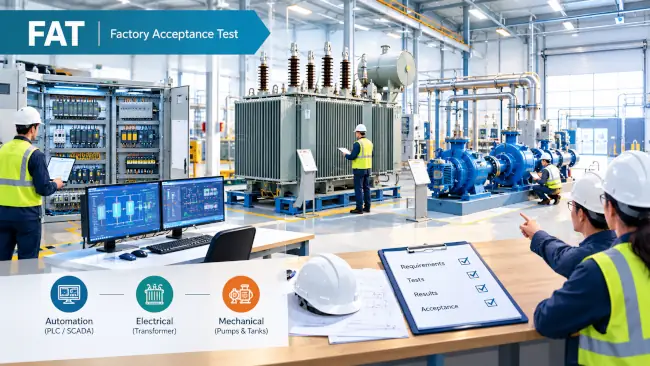
This challenge often begins during the bid and clarification stages. EPC contractors, OEMs, consultants, and client engineering teams typically work under intense schedule pressure while attempting to finalize datasheets, design criteria, interface responsibilities, and performance guarantees. During this process, many technical assumptions gradually become embedded inside procurement specifications, Factory Acceptance Test (FAT) procedures, Inspection and Test Plans (ITPs), deviation registers, and commissioning acceptance criteria.
Once approved, these assumptions gain contractual weight. However, contractual acceptance does not always guarantee operational suitability.
For example, a motor-driven package may successfully pass FAT conditions at nominal design load while remaining highly sensitive to future process variability, ambient temperature changes, utility fluctuations, or operational debottlenecking requirements. Similarly, a control system may fully satisfy startup sequences and cause-and-effect matrices while still lacking flexibility during abnormal operating scenarios or maintenance bypass conditions.
In many complex projects, the client team assumes these operational realities were fully considered during detailed engineering. Meanwhile, OEMs often assume the client will later optimize operation around the delivered design envelope. Both perspectives may appear reasonable independently, yet the inherited assumptions between them remain misaligned.

This is why technical alignment requires more than document approval workflows and compliance tracking alone. It requires continuous validation that engineering intent, operational expectations, testing philosophy, and lifecycle objectives still remain connected throughout project execution.
In Summary,
Inherited assumptions remain one of the least visible yet most influential forces inside complex industrial projects. OEMs, consultants, EPC contractors, and client teams may all fulfill their contractual responsibilities correctly while still creating long-term operational misalignment between delivered systems and real plant needs. Specifications, FAT procedures, performance guarantees, and commissioning criteria often validate compliance within defined boundaries, yet they do not always validate operational flexibility, maintainability, future expansion capability, or lifecycle resilience.
This article explored how inherited assumptions gradually become embedded across engineering decisions, testing philosophies, vendor interfaces, and project execution workflows. It also highlighted the importance of continuously validating engineering intent instead of relying solely on document approvals and contractual acceptance milestones. Strong consultants, SMEs, and project teams understand that technical alignment requires active challenge, interdisciplinary review, and lifecycle thinking throughout execution.
Modern AI-assisted engineering environments may increasingly strengthen this process by improving traceability between assumptions, specifications, design revisions, operational requirements, and downstream impacts. However, AI remains a supporting layer rather than a replacement for engineering ownership and operational understanding.
In the next discussion, we will move deeper into the project governance structure itself. We will explore the extensive ecosystem of project management controls, technical documentation, contractual frameworks, requirement registers, interface management systems, and formal change-management procedures that attempt to govern inherited assumptions across complex industrial projects. More importantly, we will examine why large volumes of documentation alone still do not guarantee alignment unless continuity, visibility, and shared understanding remain preserved throughout the lifecycle.