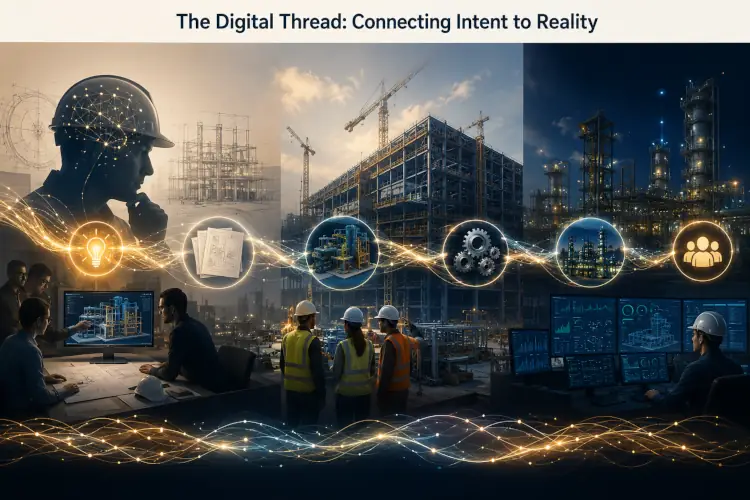
Industrial projects rarely fail because of one catastrophic mistake. Can a Digital thread save our project when most failures begin much earlier through disconnected assumptions, fragmented communication, and lost engineering intent. A specification changes without reaching operations. An OEM designs around outdated site information. A commissioning team inherits decisions nobody fully explains. Over time, small context gaps accumulate until they appear as delays, scope conflicts, safety concerns, or reliability issues.
This is where the idea of the Digital Thread can becomes important, What do you think? Not as a software trend, but as a practical method for preserving continuity from concept to commissioning. Every project phase inherits information from the previous one. When that information becomes incomplete, outdated, or isolated between teams, risk quietly compounds across the entire lifecycle.

I once experienced this during a large industrial project involving medium-voltage power distribution. Nearly two kilometers of MV cables disappeared within the scope of two separate vendors. Both OEMs believed the work belonged to the other side because their contracts were issued at different stages of the project. Consultants reviewed the design. Specialists approved technical details. Multiple teams participated in meetings and execution planning. Yet the gap survived deep into the project lifecycle because nobody owned the complete context chain from beginning to end.
Years ago, resolving such issues depended entirely on human experience, cross-checking, and costly coordination meetings. Today, many teams ask a different question. Could AI-assisted engineering reviews identify scope overlaps, missing interfaces, or conflicting assumptions before execution begins? The answer may increasingly become yes, but only if organizations preserve the right context across every project stage.
Technology alone cannot create alignment. However, connected information, disciplined communication, and collaborative review processes can dramatically reduce hidden execution risks. The Digital Thread is ultimately not about replacing engineers, SMEs, or operations teams. It is about empowering them with continuity, visibility, and shared understanding across the entire industrial lifecycle.

Early Assumptions Become Inherited Reality
Industrial projects inherit far more than drawings, specifications, and schedules. They also inherit assumptions that quietly shape future operation, maintenance, reliability, and even safety performance. Many of these assumptions originate during concept development, feasibility studies, or early design reviews, when information is still incomplete and teams work under schedule pressure.
At this stage, engineers and consultants often make reasonable decisions based on the best available data. However, once procurement starts and contracts are awarded, these early assumptions gradually become operational reality. Changing them later becomes technically difficult, financially expensive, and politically sensitive across stakeholders.
Common inherited assumptions often include:
- Cable routing distances and tray capacities
- Equipment accessibility and maintenance clearances
- Heat load and ventilation expectations
- Utility ownership boundaries between vendors
- Shutdown philosophy and redundancy logic
- Spare parts strategy and criticality ranking
- Instrumentation ranges and sensor locations
- Future expansion allowances
- Environmental and corrosion assumptions
- Operator access during abnormal conditions

Many of these decisions appear minor during design reviews. Nevertheless, they frequently resurface during commissioning, troubleshooting, or reliability investigations years later.
I have seen projects where equipment technically satisfied all contractual requirements while remaining extremely difficult to maintain in real operational conditions. In other cases, vendors optimized their own package boundaries correctly, yet critical interface responsibilities remained unclear between contractors. The technical issue itself was not always complex. The real problem was that the original design assumptions were never continuously challenged as the project evolved.
This is where the Digital Thread can become valuable. Preserving engineering intent, assumptions, and decision history across lifecycle stages allows teams to identify inconsistencies before they mature into operational risk.
Let’s see some of this assumptions in real life:
Examples I have personally experienced include designing a double busbar H-configured high-voltage GIS substation with two fully independent incomers and a bus coupler arrangement. At the time, some stakeholders viewed the configuration as excessive because the initial operational demand did not fully justify the added flexibility. However, the design later proved extremely valuable during maintenance activities, load redistribution, and future plant expansions, where operational continuity became more important than initial optimization assumptions.

I also pushed for bid documents to mandate a minimum 5% spare capacity margin across major motors and process equipment, making it part of the Provisional Acceptance Certificate (PAC) criteria rather than a preferred recommendation. The additional CAPEX impact was relatively small, yet the long-term operational benefit was significant. The approach reduced future expansion bottlenecks, provided operational flexibility during abnormal conditions, and prevented equipment from constantly operating near hard design limits.
This philosophy differed from the common industry practice where many OEM packages are delivered with motors sized very close to actual operating demand, sometimes relying on only minimal overload margins above rated load. While such designs may satisfy contractual performance requirements, they often leave operations teams with limited flexibility once process conditions evolve beyond the original assumptions.
The Digital Thread Begins Before Software
Many organizations mistakenly treat the Digital Thread as a software platform, a dashboard, or a document management system. In reality, the Digital Thread begins much earlier through disciplined preservation of engineering intent, project assumptions, design constraints, and decision history across the project lifecycle.
A drawing revision alone rarely explains why a change happened. A specification update may capture the final requirement without preserving the operational concern, risk assessment, or maintenance limitation that originally triggered the modification. Over time, projects accumulate approved changes while gradually losing the reasoning behind them. This creates one of the most dangerous forms of technical fragmentation because teams inherit decisions without inheriting context.
Well-structured project environments have traditionally attempted to reduce this risk through formal Management of Change (MoC) workflows, design review records, technical queries, deviation logs, interface registers, and assumption tracking practices aligned with modern project governance frameworks and PMI-oriented project controls. However, these processes often remain distributed across emails, meeting minutes, disconnected databases, and isolated contractor documentation.
Where is this Digital Thread already used?
This concept is also becoming visible in modern software development environments. AI-assisted engineering platforms and coding copilots increasingly use semantic indexing, vector databases, retrieval-augmented generation (RAG), and requirement-traceability frameworks to preserve the relationship between user requirements, design decisions, code changes, and technical assumptions across project evolution. Instead of functioning as simple search tools, these systems can maintain contextual memory between discussions, modifications, validation steps, and implementation logic.
A similar approach is gradually emerging in industrial projects. Engineering teams can now build connected knowledge libraries that link specifications, vendor documents, calculations, commissioning records, deviation approvals, and operational constraints into continuously searchable contextual environments. This allows AI agents and project teams to review not only what changed, but also why the change originally occurred and which downstream systems

This fragmentation becomes increasingly visible during commissioning and operational handover phases. Many commissioning surprises are simply forgotten design conversations returning at full scale.
Modern AI-supported project environments are beginning to address this challenge differently. New engineering knowledge frameworks, semantic project libraries, and AI-assisted requirement-traceability systems can now preserve relationships between assumptions, calculations, design decisions, vendor clarifications, and operational constraints throughout the project lifecycle. Instead of only storing documents, these systems can increasingly retain the reasoning path that led to technical decisions.
For example, an AI-assisted engineering review may identify that a motor sizing assumption changed after a process modification while downstream electrical load studies, cable sizing calculations, or spare capacity criteria remained unchanged. In the past, identifying such inconsistencies required extensive manual cross-checking between multiple disciplines and contractors.
The Digital Thread therefore does not begin with software deployment alone. It begins when organizations intentionally preserve continuity between decisions, assumptions, technical intent, and operational reality from concept to commissioning.
In Summary
The Digital Thread is ultimately not about software alone, nor is it a replacement for engineering judgment and operational experience. Its real value comes from preserving continuity between assumptions, decisions, technical intent, and operational reality throughout the entire project lifecycle. Every specification, calculation, vendor clarification, design review, and commissioning activity contributes to a larger chain of inherited context. When that chain weakens, projects become increasingly vulnerable to hidden risks, fragmented ownership, and costly surprises during execution and operation.
The examples discussed here demonstrate how early assumptions can quietly shape long-term operational outcomes. Small design decisions regarding redundancy, spare capacity, accessibility, or scope boundaries often return years later as either operational advantages or reliability limitations. Modern AI-assisted engineering environments may increasingly help organizations preserve this continuity, identify inconsistencies, and strengthen project awareness across disciplines. However, technology remains only an enabler. Human understanding, disciplined communication, and lifecycle thinking still define project success.
In the next parts of this discussion, we will explore how OEM assumptions often diverge from real site conditions, how engineering intent becomes diluted between project phases, and how commissioning teams frequently inherit technical decisions without inheriting the original operational context behind them.