Once the OEM completes manufacturing and resolves the agreed FAT observations, the equipment can be released for shipment. That’s when we need to answer: Will Site be Really Ready to receive the equipment on time? If not, what can we do? In our previous article, Project Testing: From FAT to Full Operational Confidence, we followed the equipment through Factory Acceptance Testing (FAT).
But will other project activities simply start after the equipment arrival?
Certainly not.
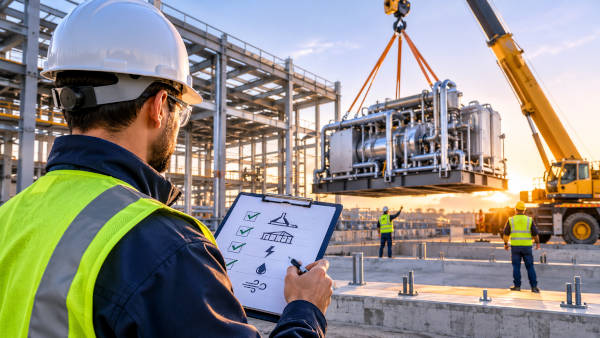
While the OEM is manufacturing or customizing the equipment, another important activity should already be progressing at the project site: preparing the site to receive it.
This applies to every project size. We might be constructing a complete production line, equipping a new workshop with a few machines, or adding one machine to an existing production line. The scale changes, but the principle remains the same.
We need to prepare the physical space, foundations, buildings, steel structures, access routes and supporting infrastructure. We also need to consider the required utilities, including electricity, water, compressed air, fuel and other process gases. Material receiving, handling and product transfer arrangements also need attention.

This preparation must follow the equipment requirements and approved project documents. Installation drawings provide essential information about dimensions, foundation requirements, equipment loads, clearances and connection points. Utility requirements and interface documents help us identify the necessary supplies and take-over points.
The objective is straightforward: when the equipment arrives, the site should be ready to receive it without unnecessary modifications, delays or additional work.
The OEM is preparing the equipment. We should be preparing its place in the industrial facility.
Is the Site Really Ready for Equipment Arrival?
Site preparation starts with understanding what the equipment needs, not simply identifying where it will be installed.
The OEM provides installation drawings and technical documents that define the equipment dimensions, weights, foundation requirements, support loads, clearances and connection points. These documents form the basis for preparing the installation area and coordinating the supporting civil, structural and utility works.
The project team must review these requirements against the actual site conditions. Are the foundations suitable for the equipment loads? Do the building dimensions and steel structures provide sufficient clearance? Can the equipment reach its final position through the available access routes? Are the required cable routes, piping connections and utility interfaces properly considered?

This review should also identify the information needed from the OEM before construction progresses too far. Equipment dimensions and loads may change during detailed engineering, particularly when the OEM customizes a standard design for the project. Relying on preliminary drawings without tracking revisions can create expensive modifications later.
The same principle applies when adding a single machine to an existing production line. Available space does not necessarily mean installation readiness. Existing structures, foundations, cable routes, electrical supply, utilities, piping, operating access and interfaces with nearby equipment may all require modification or coordination.
Site readiness begins with knowing exactly what we are preparing the site for.
Verify Before Access Becomes Difficult
Some installation requirements must be checked before equipment arrival and before construction activities reach their final stages. These checks prevent hidden defects, inaccessible connections and costly modifications later.
| Item | What to verify before access is restricted |
|---|---|
| Foundations and anchor bolts | Dimensions, levels, positions, elevations and embedded components |
| Embedded plates and supports | Position, orientation, dimensions and installation quality |
| Underground piping | Routing, supports, connections and specified pressure or leak tests |
| Cable trenches and ducts | Routing, dimensions, accessibility, cleanliness and required separation |
| Concealed electrical services | Installation inspection and applicable continuity or insulation tests |
| Drainage and underground channels | Levels, slopes, connections and flow tests where applicable |
| Building openings and lifting routes | Dimensions, clearances, equipment access and lifting arrangements |
| Concealed services above ceilings or floors | Routing, connections, supports and applicable inspection or testing |
| Electric Power and Utilities | Existing sources can provide the utilities in the quantity and quality needed |
These are not final installation acceptance tests. Equipment installation, grouting, final connections and subsequent testing will still follow their own procedures. At this stage, we confirm that the prepared infrastructure meets approved requirements before the next construction activity makes inspection difficult or impossible.
The rule is simple: inspect and test what you can now, before the next activity hides it.

Preparing the Utilities: Are They Ready Where They Are Needed?
Industrial equipment rarely operates independently. It depends on supporting utilities that must be available at the right location, with the required capacity and operating conditions.
Electrical power is an obvious example, but it is not the only one. Depending on the equipment and process, we may need cooling water, process water, compressed air, hydraulic power, fuel, natural gas, oxygen, nitrogen or other process gases. Some equipment also requires dedicated extraction, ventilation or dust collection systems.
Preparing these utilities involves more than extending pipes and cables to the equipment area. We need to understand the required consumption, pressure, flow, temperature, voltage, frequency, quality and reliability. These requirements should come from the OEM documentation and the overall process design.
We must also examine the supply infrastructure. Is the electrical distribution system capable of handling the additional load? Can the cooling water system provide the required flow and temperature? Are compressors, pumps, gas supply systems and storage facilities adequate for the additional demand?
Connection points require particular attention. The OEM may define the take-over points where the supplier’s scope ends and the plant’s utility infrastructure takes responsibility. These interfaces must be clearly identified, coordinated and prepared before equipment installation.
Finally, we should consider how utilities will be tested and made available. Completing a pipeline or installing a cable does not prove that the required service is available at the equipment connection point. Inspection, testing and commissioning of the supporting utility systems must follow the project requirements.
A utility is ready only when it can deliver the required service, at the required location, under the required conditions. That what a site really ready means.
New Facility or Existing Plant: Two Different Engineering Challenges
Utility engineering is critical in both greenfield projects and additions to existing production facilities. However, the engineering approach and challenges can differ considerably.
In a new facility or production line, utility requirements are normally considered as part of the overall design. The project team can size new substations, transformers, water treatment plants, cooling systems, compressors and gas supply stations according to the expected demand and future expansion plans.
Adding equipment to an existing facility presents a different challenge. We must first understand the capacity and actual operating conditions of the existing utility systems. Available capacity on paper does not necessarily mean that sufficient capacity is available during peak production or when other consumers operate simultaneously.
Finding additional electrical power, cooling water or compressed air can sometimes be more difficult than building a new substation or utility station. Existing infrastructure may have limited spare capacity, restricted installation space, operational constraints or complicated distribution networks. Connecting new equipment may also require modifications that affect existing production.
Therefore, an expansion project needs more than the new equipment’s utility consumption figures. It requires an assessment of existing demand, available capacity, operating margins, distribution constraints and the impact of the additional load.
The project team must then compare the available options: upgrading existing infrastructure, installing dedicated utility equipment or constructing a new utility station.
An existing plant gives us infrastructure to build upon, but it does not guarantee the capacity we need.
Making the Site Really Ready: What Comes Next?
Preparing a site for equipment arrival involves much more than providing sufficient floor space and completing foundations. It requires coordinated engineering and construction activities that ensure the equipment can be received, accommodated and connected to the required infrastructure.
In this article, we explored how to start with the OEM’s installation drawings and technical requirements, then translate them into actual site preparations. We examined foundations, buildings, steel structures, access arrangements and underground services. And, we highlighted the importance of inspecting and testing concealed works before they become inaccessible.
We then looked at utilities, from electrical power and cooling water to compressed air, fuel and process gases. Their availability, capacity and connection points require careful engineering. This becomes particularly challenging when adding equipment to an existing facility, where available capacity may be more difficult to secure than developing new utility infrastructure.
Consider this article a practical handbook full of engineering insights to help make your site really ready for equipment arrival. The objective is to identify requirements early, coordinate the responsible parties and avoid discovering missing infrastructure when the equipment is already waiting at the site.
But site readiness is only the first step.
Once the equipment arrives, the focus shifts to installation. We need to verify that it is positioned, assembled and connected according to the approved drawings, installation procedures and agreed standards.
That will be our next subject: Installation Verification — Was the Equipment Installed Correctly?
Because preparing the site is one challenge. Making the equipment part of the industrial facility is another.